
Introduction: The Collapse of the Blue Link Era
For over twenty years, digital marketing operated under a single, unchanging contract: a user typed a query into a search bar, scrolled through a list of ten blue links, and clicked the result that looked most promising. Search Engine Optimization (SEO) was built on this exact infrastructure. Winning meant capturing position one through three, securing organic traffic, and converting visitors once they arrived on your domain.
That era has officially closed.
As we navigate through 2026, the search landscape has transitioned entirely to conversational, AI-driven engines. Platforms like ChatGPT, Perplexity, Google AI Overviews, Microsoft Copilot, and Claude have fundamentally transformed how humans find information. Users no longer want to open five different tabs to piece together an answer. They ask complex, multi-layered questions, and they expect an immediate, synthesized, and definitive response.
This shift has introduced a zero-click reality where traditional search traffic metrics are contracting, yet brand authority and visibility are more concentrated than ever. Ranking on page one of Google is no longer the ultimate finish line. Being understood, selected, and cited by AI models is the new battleground.
This guide explores Generative Engine Optimization (GEO)—the science, strategy, and execution framework required to dominate AI search results and secure your brand's position as a primary source inside LLM-generated answers.
1. What is Generative Engine Optimization (GEO)?
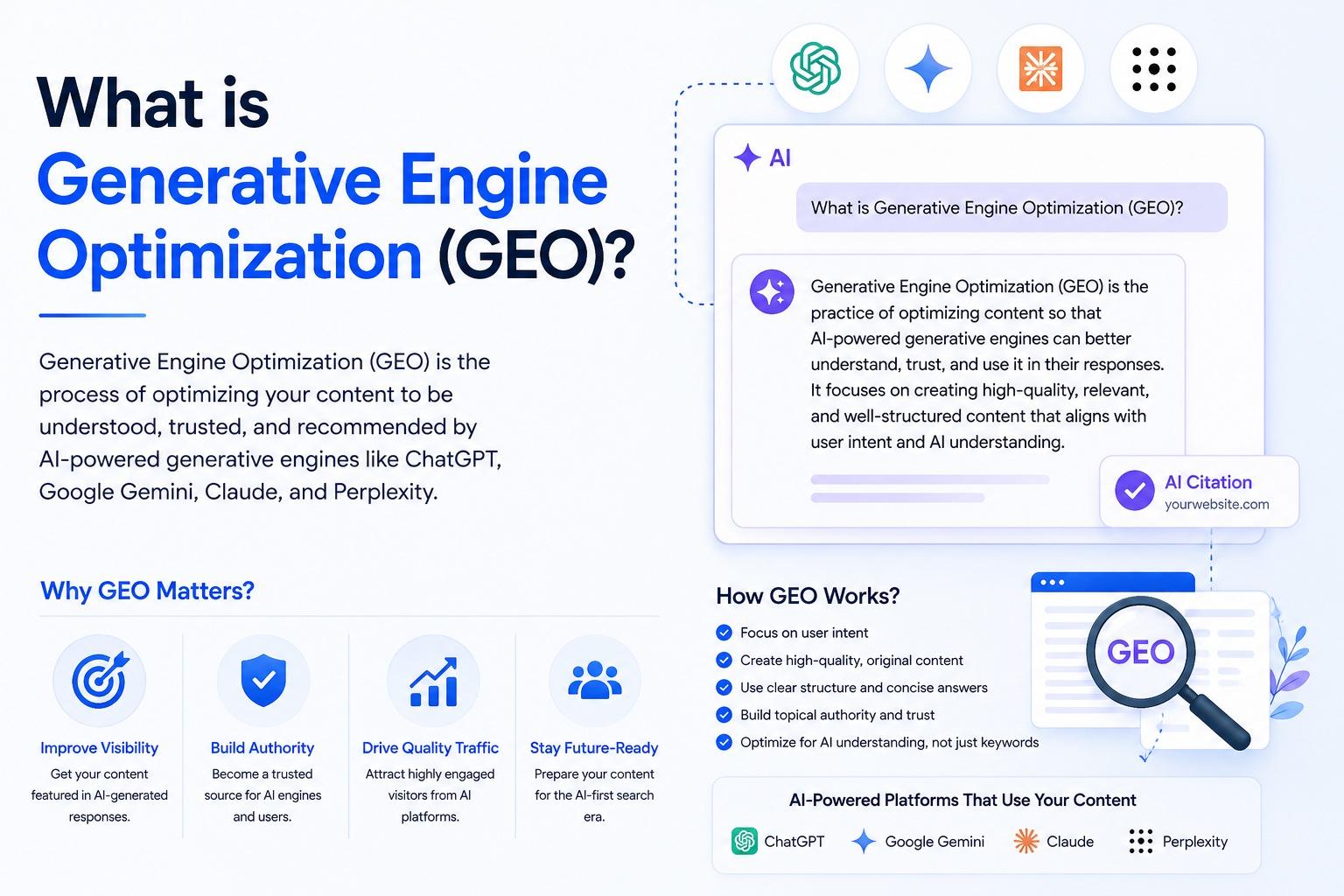
Generative Engine Optimization (GEO)is the strategic discipline of researching, writing, structuring, and distributing content so that Large Language Model (LLM)–powered search engines select, trust, and cite your brand inside their generated responses.
While traditional SEO targets keyword rankings on a results page, and Answer Engine Optimization (AEO) targets direct snippet extractions, GEO targets the multi-source synthesis layer. When a user prompts a generative engine, the system uses Retrieval-Augmented Generation (RAG) to scan live web data, evaluate credibility, extract facts, and weave together a unified narrative response. GEO ensures that your brand's data, statistics, expert quotes, and entity profile form the foundational building blocks of that narrative.
The Scientific Foundation: The Princeton GEO Study
GEO is not just an industry buzzword; it is a mathematically backed optimization framework. The discipline stems from foundational research originally published by researchers from Princeton University, Georgia Tech, the Allen Institute for AI, and IIT Delhi (Aggarwal et al.).
Using the GEO-bench framework across thousands of simulated queries, the study proved that targeted content optimizations can boost an AI visibility score by 22% to 41%, depending on the domain and strategy applied. Most importantly, the study proved the “Equalizer Effect”: lower-ranked sources (such as a page sitting at position five on a search engine) saw a massive 115.1% boost in AI visibility when properly optimized with statistics, quotations, and authoritative clarity.
2. SEO vs. AEO vs. GEO: The Modern Search Hierarchy
A common panic in digital marketing circles is the false notion that “SEO is dead.” In reality, search has not died; it has layered. To succeed in 2026, you must understand how SEO, AEO, and GEO work together as an interconnected ecosystem.
| Dimension | Traditional SEO | Answer Engine Optimization (AEO) | Generative Engine Optimization (GEO) |
|---|---|---|---|
| Core Objective | Rank in positions 1–10 for targeted keywords. | Secure direct extraction inside short snippet boxes. | Be cited as a trusted source within complex AI-synthesized narratives. |
| Primary Unit of Value | A traditional web click. | A direct text quote or structured snippet. | An inline citation, brand mention, or recommendation link. |
| Technical Mechanism | Crawling, indexing, backlinks, and Core Web Vitals. | Semantic HTML, direct answer blocks, and FAQ schema. | RAG pipelines, entity-first content graphs, and fact density. |
| Success Metric | Organic rankings and sessions. | Snippet win rate and CTR. | AI Citation Frequency (AICF) and Share of Model. |
Think of traditional SEO as the concrete foundation of a house, AEO as the front door signage, and GEO as the interior architecture that makes the house functional and appealing to high-value guests.
3. The Core Pillars of a Winning GEO Strategy
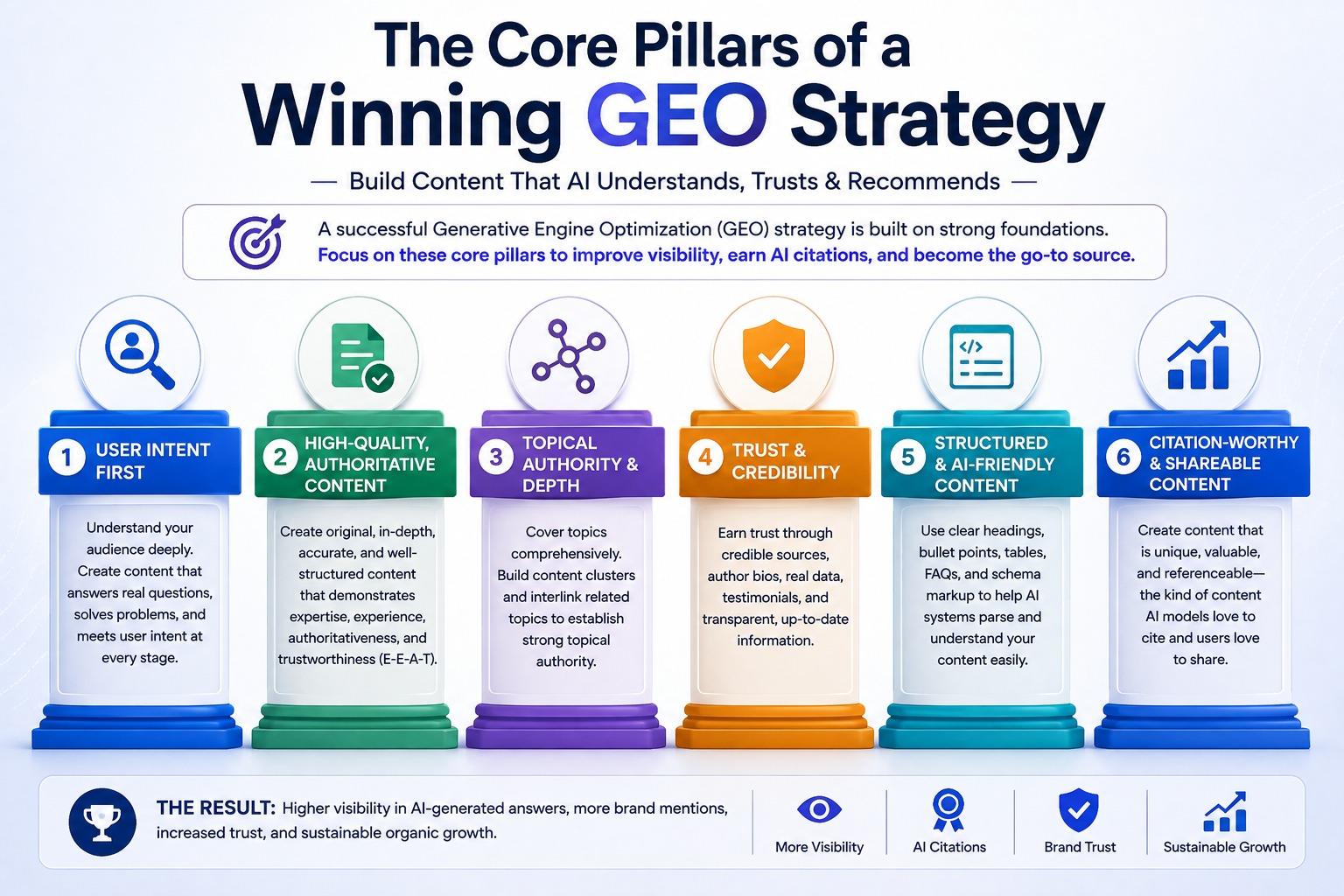
Based on empirical data from academic research and modern AI search behavior, winning a high Share of Model in ChatGPT and Perplexity requires a specific set of content adjustments.
1. Statistics Addition and Verifiable Data
The Princeton study revealed that incorporating relevant statistics is one of the single most powerful ways to boost AI visibility, delivering significant gains on word count retention and subjective impression scores.
- The Mechanism: LLMs are trained to prioritize factual grounding to prevent hallucinations. When your content contains precise data points, metrics, and figures, the model views it as a high-value anchor.
- Execution: Never write vague generalizations like “AI search has reduced click-through rates significantly.” Instead, write: “Ahrefs' 2026 analysis found that AI Overviews reduced click-through rates on top-ranking content by 58%.” Specificity earns citations.
2. Quotation Addition and Expert Attribution
AI models search for human expertise and authoritative perspectives to validate claims.
- The Mechanism: Adding direct quotes from named domain experts increases the perceived authority of a text block, making it a prime candidate for LLM extraction.
- Execution: Feature original commentary, executive insights, and named expert quotes within your content body. Pair these quotes with proper schema author attribution (
Personschema) so the AI crawler can verify who said it.
3. Fluency Optimization and Technical Terminology
Unlike older SEO tactics that rewarded awkward keyword repetition (keyword stuffing actually penalized visibility by up to 10% in tests), generative engines favor exceptional linguistic fluency.
- The Mechanism: LLMs process language probabilistically. Content that flows naturally, uses sophisticated vocabulary, and integrates precise technical terminology reduces the computational overhead required for the model to parse and summarize the text.
- Execution: Write cleanly, avoid fluff, and use industry-standard terminology naturally throughout your paragraphs.
4. Entity-First Content Structuring
AI engines do not view the web through loose strings of keywords; they view the world through entities—defined people, organizations, products, and concepts.
- The Mechanism: An AI search engine maps your content against a global knowledge graph. If your brand entity is disconnected from the core concepts of your industry, the model will struggle to recommend you.
- Execution: Explicitly link your brand name to core industry entities, proprietary tools, and standard frameworks across your site architecture.
4. Step-by-Step GEO Playbook for 2026
Executing a systematic Generative Engine Optimization strategy requires moving through four distinct operational phases.
Phase 1: Audit Your Current AI Visibility (Share of Model)
Before rewriting your web presence, establish a baseline. Use specialized AI visibility tools to test how major engines (ChatGPT Search, Perplexity, Claude, and Gemini) describe your brand across 30 to 50 core industry prompt variations.
- Are you cited as a market leader?
- Are competitors stealing your recommendations?
- Is the AI sentiment positive, neutral, or inaccurate?
Phase 2: Restructure Content for RAG Pipelines
Optimize your page layouts specifically for how retrieval-augmented generation models scan and extract text chunks.
- Inverted Pyramid Design: Place a clear, concise definition or summary directly beneath every major
H2header. - Clean Formatting: Utilize structured lists (
<ol>,<ul>) and standard HTML tables (<table>) for comparisons and pricing data. Avoid complex graphics or text locked inside images. - Schema Stacking: Implement comprehensive JSON-LD schema across your domain, focusing heavily on
Article,FAQPage,HowTo, andDatasetschemas.
Phase 3: Build Cross-Web Authority and Citation Chains
An AI engine rarely relies on a single isolated website to build a high-stakes response. It checks cross-web consensus.
- The Citation Network: Ensure your brand is actively mentioned on high-authority third-party platforms that LLMs crawl heavily, such as Reddit, Wikipedia, Wikidata, niche industry forums, and digital PR publications. Unlinked brand mentions on trusted sites carry immense weight in modern AI citation algorithms.
Phase 4: Maintain Temporal Freshness
Generative engines heavily weight recency, especially for queries involving fast-moving industries, technology, or current market trends.
- Establish a strict quarterly content refresh cycle. Update your statistics, refresh your visible publication dates, and ensure your machine-readable schema timestamps reflect active maintenance.
The evolution from traditional search rankings to generative engine citations is the most profound structural shift in digital marketing history. Brands anchored to legacy keyword optimization will watch their organic traffic contract as zero-click AI interfaces absorb user intent.
By embracing Generative Engine Optimization, injecting verifiable statistics, optimizing for linguistic fluency, and building a robust entity-driven digital footprint, you ensure your brand is not left out of the conversation when modern consumers ask AI for the best solutions in your industry.
Frequently Asked Questions
What is Generative Engine Optimization (GEO)?
Generative Engine Optimization (GEO) is the practice of researching, writing, and structuring web content so that AI-powered search engines—like ChatGPT, Perplexity, and Google AI Overviews—select, trust, and cite your brand within their generated answers.
How does GEO differ from traditional SEO?
Traditional SEO focuses on optimizing web pages to rank high within a list of blue links on a search results page, measured by clicks and traffic. GEO focuses on optimizing content structure, fact density, and citation signals so LLMs choose your brand as a source inside synthesized text answers.
What were the key findings of the Princeton GEO study?
The Princeton-backed GEO study demonstrated that targeted optimization strategies—specifically adding verifiable statistics, expert quotations, and source citations—can boost AI visibility by 22% to 41%, with lower-ranked pages experiencing massive equalizer gains.
Does keyword stuffing work in GEO?
No. Research proves that keyword stuffing performs significantly worse than unoptimized baseline text in modern AI search engines like Perplexity, as LLMs penalize redundant or unnatural phrasing.
Want your content engineered for RAG pipelines and Share of Model, not just rankings? Get in touchand we'll run your GEO audit.